
Find Twentynine Palms Residents
Start with what you need to prove, because naming the question saves hours. An address question starts at the city GeoViewer or County Parcel Access. Ownership questions move next to the Assessor. They also go to San Bernardino County's combined Assessor-Recorder-County Clerk, known as ARC. Court matters belong to the Superior Court's Court Access Portal. Family history runs through the Historical Society Research Library. Old newspapers, census pages, and the cemetery index round it out. Every record has a keeper, a date, and a limit.
No single roll names everyone tied to a parcel. An assessed owner is one ownership lead, never a full household. Voter records sit behind authentication or a qualified statutory request. So a public street browse will not reach them. A directory listing places a name somewhere at one time. A missing name could mean an unlisted number. It could also be a spelling change, a move, or a gap in the collection. Keep those distinctions visible. That habit separates a solid residents directory search from guesswork.
- Start with the address, parcel, or full name that is already known. Use the city map or county parcel map to make the location precise.
- Save the APN, situs address, legal description, and date shown by the parcel source. Treat a mailing address as correspondence, not proof of occupancy.
- Move to ARC's Recorder index when a person, entity, or instrument is the next lead. Search both grantor and grantee roles and preserve the document number.
- Use the court, vital, voter, license, business, cemetery, or historical source that matches the question. Do not treat a null result as a complete negative.
- Ask the custodian for an identifiable existing record when the useful material is not online. A California Public Records Act request should name the office, subject, record series, and date range.
Work the chain in order. A broad resident search then becomes a short series of dated evidence. Later corrections get easier too, because each fact can be traced back to the office that created it.
Twentynine Palms Resident Records
Twentynine Palms records sit in several offices. City Hall holds material dating to the city's 1987 incorporation. San Bernardino County ARC, the Superior Court, the Registrar of Voters, state departments, and local historical collections hold the rest. Some newspaper and community records reach much farther back. The county seat is San Bernardino, so a local address can send a researcher to an office outside the city.
Deeds need one bridge. The ARC Official Public Records and Recorder's Index lists those filings, but it is not an address-based resident roster. Parcel Access supplies the APN. The Recorder needs that assessed-owner lead first. Election questions work differently. My Elections Gateway is a self-service tool, not a public resident lookup. The Joshua Tree court district, the county vital desk, and the city clerk each keep their own record families.
San Bernardino County ARC Recorder
222 W. Hospitality Lane, first floor
San Bernardino, CA 92415-0022
909-387-8306
San Bernardino County Assessor
Parcel Access and Property Information
Countywide map and parcel search
909-387-8306
San Bernardino Registrar of Voters
777 E. Rialto Avenue
San Bernardino, CA 92415-0770
909-387-8300
Joshua Tree Court District
6527 White Feather Road
Joshua Tree, CA 92252
San Bernardino Superior Court
Bridge a Twentynine Palms Address
Start with the polygon. The address-to-owner bridge is the most important move in local research. The Twentynine Palms GeoViewer takes an address or an APN and returns roads, aerial imagery, parcels, city and Sphere of Influence layers, zoning, land use, trails, flood, and seismic overlays. County Parcel Access adds a countywide parcel view. Copy the APN and the legal or situs details before you search for a person.
A mailing address can differ from the situs address. That split hints correspondence goes elsewhere. It still does not prove who occupies the parcel. Assessment values, exemptions, and owner-transfer dates come from the property roll. They are not a title opinion. Nor are they a household list. That is why the Twentynine Palms residents directory works best as a linked set of records rather than one answer.
The map also settles jurisdiction. A postal city, the incorporated boundary, the Sphere of Influence, the Marine installation, and the assessor's county jurisdiction overlap in confusing ways. Note which layer supplied each conclusion. The city GeoViewer map shows the parcel and boundary layers that make this first bridge possible.
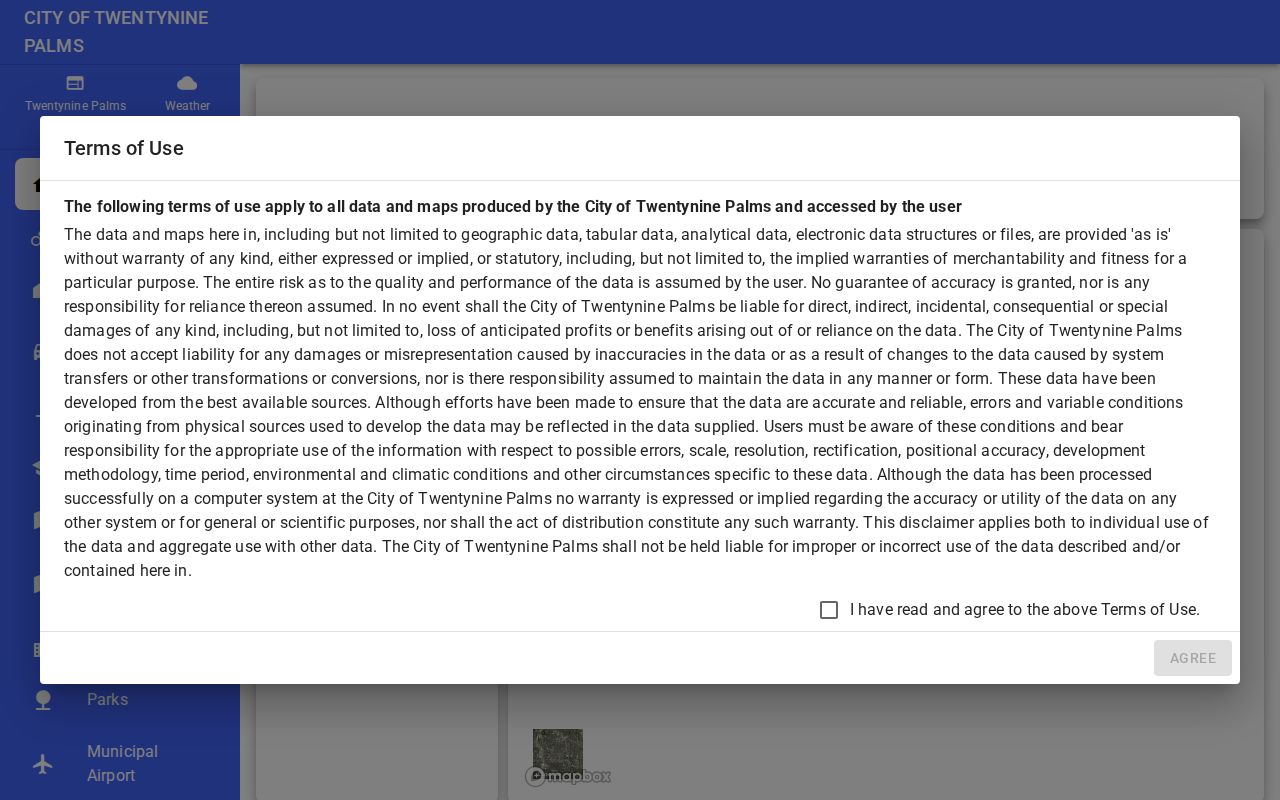
A parcel match is only a location lead. Before any resident of Twentynine Palms can be narrowed further, it needs a dated instrument or some other lawful record tying a name to that parcel.
Note: An APN identifies a tax parcel, while a person record needs its own dated source and identity check.
Twentynine Palms Recorder Search Starts Here
ARC's Recorder index earns its keep once the parcel bridge is done. It cannot find ownership by street address, though. Search the assessed owner as grantee first. Match the legal description. Then pull the earlier grantor from the deed, and run that person as a prior grantee. Log the spelling, document number, recording date, title, and legal description at every step. What you get is a transaction chain. It is not proof that every party lived on the property in Twentynine Palms.
The remote index is catalog metadata only. To view images, visit the Hall of Records or Hesperia. You can also order copies from the county. The county describes a general index reaching back to 1925. Its detailed property-research guide treats the grantor and grantee chain as practical from 1958 forward. Names earlier than that point lead to decade microfilm at the main Recorder. Both date layers matter for a Twentynine Palms records workflow. They answer different access questions for anyone using the county residents directory alongside property rolls.
The Recorder Self-Service entry path shows the county's official index gateway.
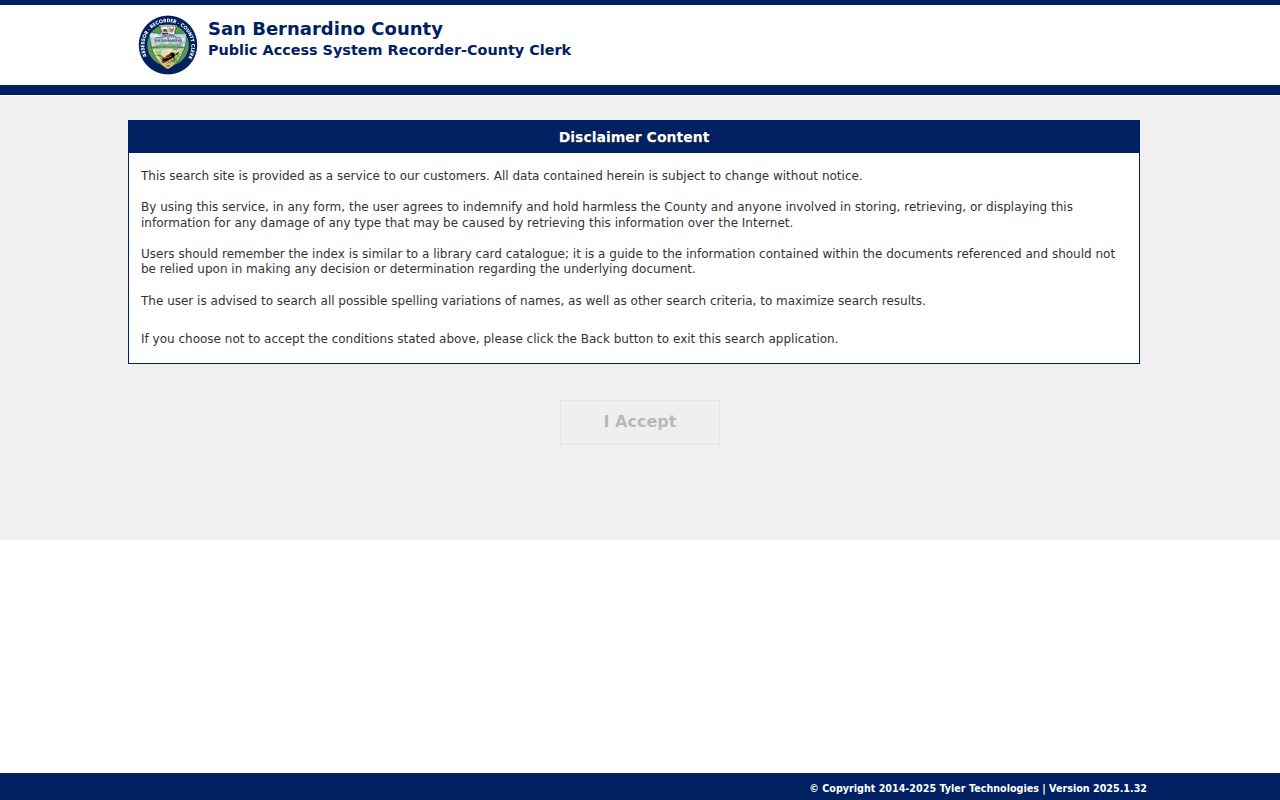
Order a copy using the document number, or the book and page, pulled from the index. Noncertified copies arrive by email. Certified records ship instead. Office inspection is the fallback when no image displays remotely.
Twentynine Palms Record Layers
Two official statements about Twentynine Palms records can look contradictory until you name their scope. ARC advertises a general index starting in 1925. The county property-research guide, meanwhile, describes a practical grantor and grantee chain from 1958 forward. Earlier decades sit on microfilm at the main Recorder. The first date measures how far the index reaches. The second marks the working chain a researcher can follow through the modern process. Anything before 1958 may mean a different visit, a different format, or help from staff.
The same caution travels across other Twentynine Palms sources. San Bernardino Superior Court warns that electronic court data before 1998 may be limited. Municipal records run recent because the city formed in 1987. The County Archives holds probate from 1853 to 1926. It also holds Great Registers of Voters from 1866 to 1908. A Twentynine Palms records search gets sharper when each date is labeled. Is it index coverage, image coverage, institutional life, or one collection's run?
Research clue. If a modern web search stops at a date boundary, move to the county counter, decade microfilm, Archives staff, or a local historical collection before treating the gap as a missing person.
Twentynine Palms Directory Sources Today
Today's directory-style sources each answer one slice of the resident question. The property roll works best for a parcel and an assessed ownership lead. My Elections Gateway lets a voter check personal registration and ballot logistics. The Recorder names parties to instruments. City legislative search surfaces names in minutes. It also surfaces claims, contracts, appointments, public comments, and other municipal documents. None adds up to a complete resident roll.
| Source | What It Can Identify | Keeper | Access |
|---|---|---|---|
| Parcel Access property roll | APN, situs, assessed owner lead, values | San Bernardino County Assessor | Free public map |
| Recorder index | Grantors, grantees, document dates and types | County ARC | Free index; copies by order or office |
| My Elections Gateway | A voter's status, districts, ballot and polling details | County Registrar of Voters | Authenticated self-service |
| City E-Resources Library | Names in public municipal documents | Twentynine Palms City Clerk | Free keyword search |
| Historical Society files | Past names, families, organizations and events | Research Library and Archives | On-site research hours |
Match the source to the fact you need. For one person, compare two dated records. Then hold onto a stable identifier: an APN, case number, entity number, license number, or document number. For a street, walk each APN through the parcel and deed chain. For older names, layer in newspapers, census pages, yearbooks, cemetery records, and oral histories. The one-person path is laid out in the Twentynine Palms resident lookup page.
| Official source | Compared with a commercial people-finder tool |
|---|---|
| Custodian, named record, dated entry | Compiled data may mix dates, spellings, and sources |
| Access rules and copy limits are stated | Search result scope and freshness may be unclear |
| Correction goes to the office that created the record | Corrections may require separate opt-out or support steps |
Note: A directory-like source is useful only when its keeper, date, search key, and limits are recorded with the result.
Twentynine Palms Voter Data Boundary
California voter information is not a public street roster. My Elections Gateway is an authenticated service. It covers registration status, districts, sample ballot and voter guide details, polling places, drop-off locations, mail-ballot and provisional status, election results, officials, and official campaign-finance records. Voting history does not appear online through the self-service page. Personal registration questions go to the Registrar at 909-387-8300.
A state or county voter file demands a qualified purpose under Elections Code section 2194. The delivered file may include name, date of birth, registration date, residence and mailing address, precinct, contact information, and party preference. Optional participation history and district data can ride along. Excluded are driver license or ID numbers and the last four Social Security digits. Also excluded are unique IDs, signatures, confidential voter data, preregistrant data, and Safe at Home participants.
The My Elections Gateway explanation makes the split clear. A personal self-check and a qualified file request are different access channels.
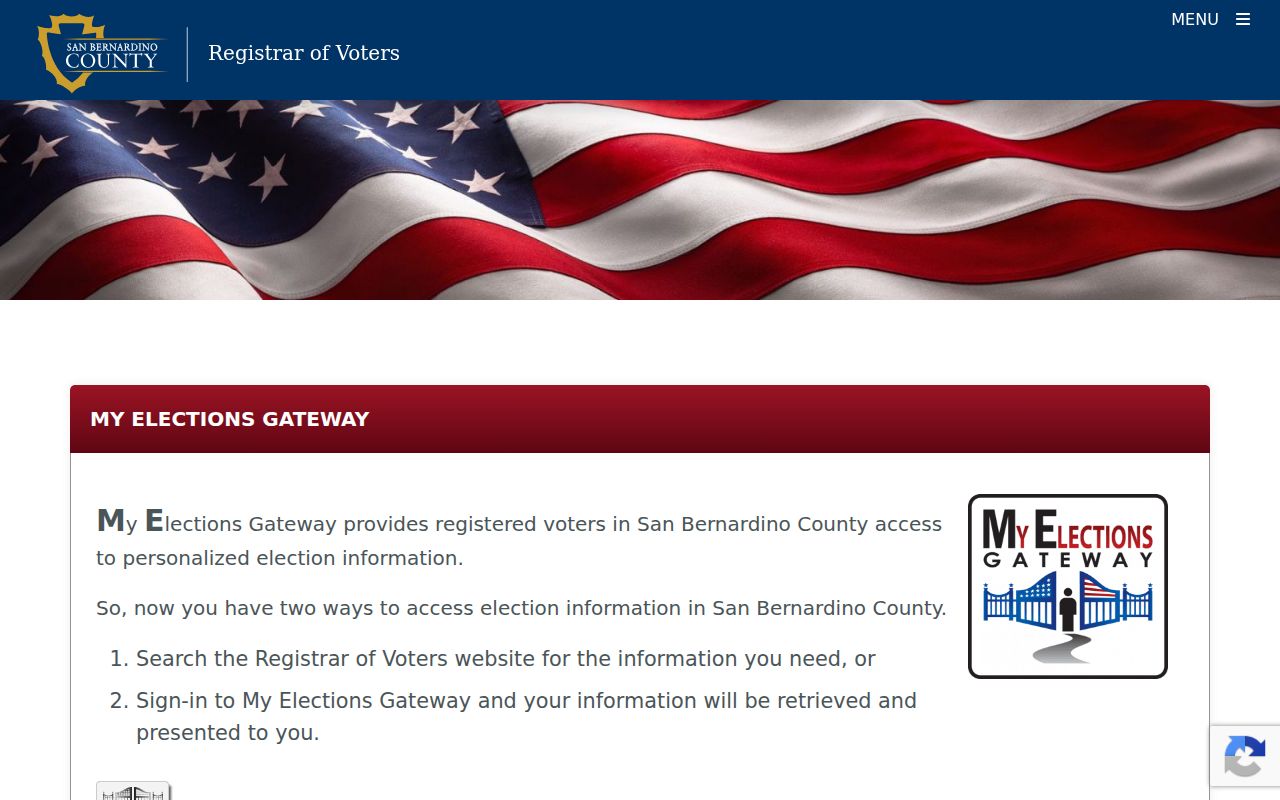
Never redistribute a search result outside its approved purpose. For genealogy or plain neighborhood curiosity, stick with the parcel, court, newspaper, cemetery, or historical sources that are genuinely open for that work.
Twentynine Palms Vital Copy Choices
California has no simple rule for opening records. It does not open every birth record at one age. It does not open every death record at another. San Bernardino County instead offers authorized certified copies and certified informational copies. These fall under Health and Safety Code sections 103525 and 103526. Confidential marriage records go only to spouses or by court order. Adoption, sealed, and amended records follow rules of their own.
The county form asks for the certificate type, exact name, event city or town, and event date. It also asks for parent details when required, relationship, purpose, copy type, contact information, and signature. A mailed authorized request needs a notarized sworn statement. An in-person authorized request requires photo identification plus a witnessed signature. Every different record needs its own form. A no-record search can still retain the fee and issue a Certification of Search.
County ARC handles county events. The California Department of Public Health offers a statewide alternative. The county cautions that some 1972 to 1977 birth copies take longer. Social Security numbers are redacted during that span. Treat a delay in that range as specific. It is not a norm for every birth request.
The San Bernardino County vital-records page lays out the copy choices and ordering channels.
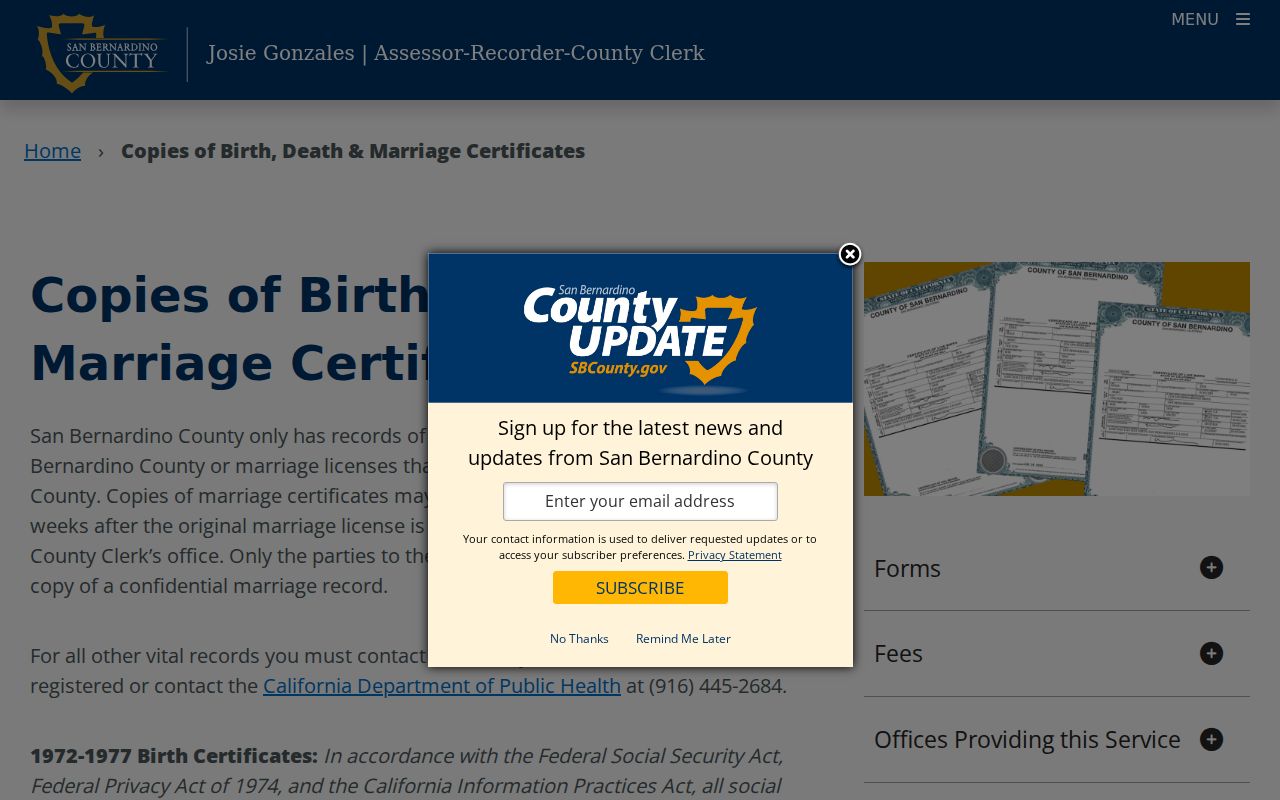
For family research, pair a lawful copy route with newspapers, cemetery entries, or probate. Those sources help identify an event. Still, they cannot replace a certified certificate when a formal record is required.
Twentynine Palms Court Data Stops Online
The Superior Court case-information hub is the county-wide entry point. It serves anyone tracing a Twentynine Palms name through court records. The portal offers name search, case search, calendar hearing search, quick search, favorites, payments, and document purchase. Searching by case number is safer. It avoids the same-name mix-ups that plague a plain name query. That matters in a county as large as San Bernardino.
Results can show parties and filed-document titles and dates. They can also show hearings, status where entered, and whether a document can be viewed or bought remotely. Electronic data before 1998 may run thin. Juvenile, adoption, sealed, and confidential files stay unavailable. Family and criminal detail is often limited remotely. Some public documents are courthouse-only under California Rule of Court 2.503. The Joshua Tree District at 6527 White Feather Road serves as the practical local counter. It handles records it retains. A file hidden from remote view is still a real file.
Federal cases live elsewhere. They require a separate Central District of California or PACER search.
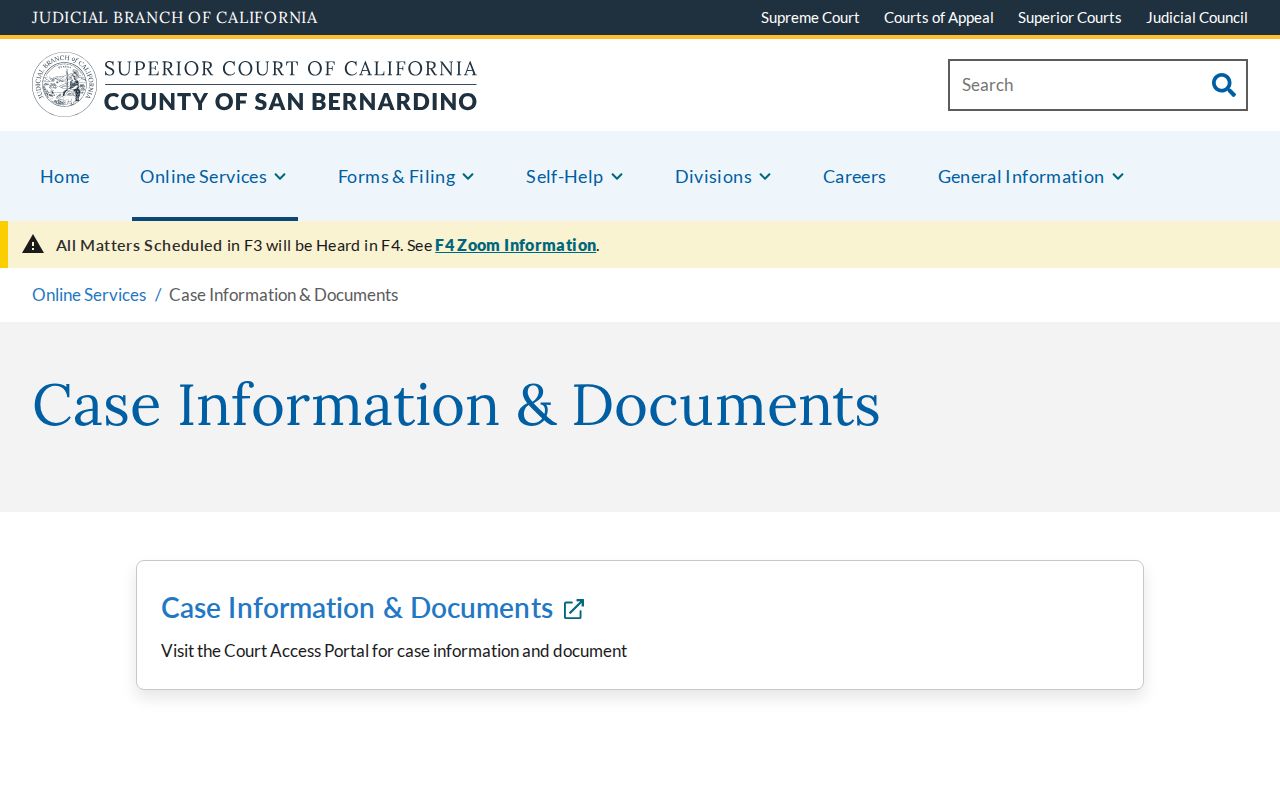
Keep case number, party role, filing date, and record type together. A name alone is a weak match, especially when the portal has older gaps or a document is protected.
Older Twentynine Palms Directory Trails
The deepest local name trail sits at the Twentynine Palms Historical Society Research Library and Archives. It is housed in the Old Schoolhouse Museum at 6760 National Park Drive. The collection is wide. It holds every issue of Out Post from July 14, 1932 through May 26, 1934. It also holds nearly every The Desert Trail from April 18, 1935 to the present. It also keeps assorted 29 Palms News issues from 1960 to 1976. Beyond the newspapers sit people vertical files, family histories, yearbooks, organization records, oral histories, books, and photographs.
The Society dates to 1982. It formed before city incorporation. Its shelves therefore preserve a name history that municipal files never held. Newspaper announcements, obituaries, civic notices, base publications, and school records can tie a person to a place. This helps when no printed directory exists. A solid citation notes the publication, date, page, box or folder, and exact spelling.
The Historical Society research archive lists the collection's hours and holdings.
Treat each item as a dated source. It cannot prove a person stayed at one address for every year between issues.
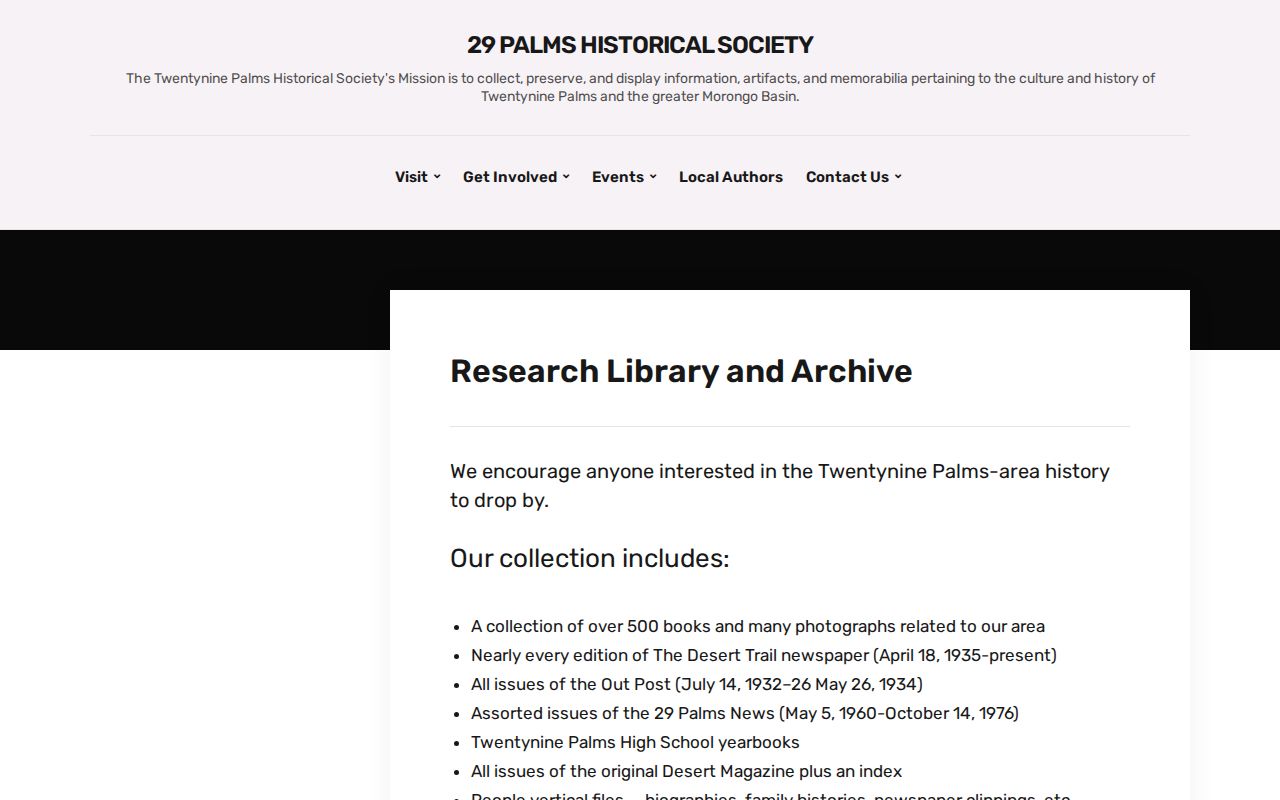
Use the historical collection as a dated source, not as proof that a person remained at an address for every year between issues.
Search 29 Palms Spelling Variants
Older material spells the place three ways: Twentynine Palms, Twenty-Nine Palms, and 29 Palms. Each variant can surface different results. The Library of Congress item covers regional telephone directories. It includes a December 1950 classified telephone directory. It names Banning, Beaumont, Cathedral City, Desert Hot Springs, and Joshua Tree. Palm Springs, Twenty-Nine Palms, and Yucca Valley also appear. Entries include Desert Accounting Tax Service at the 29 Palms exchange. Lear Bob appears on 29 Palms Highway.
Search every spelling. Then browse nearby scanned pages. OCR can miss a hyphen, a shortened locality, or a faded line. Record the road text, locality, exchange, and number exactly as printed. The item is a regional classified telephone directory, not a complete white-pages or criss-cross run. Treat it as one clue among many.
The Library of Congress directory record documents that regional item. For a final spelling, trust the image over any modern transcription.
Twentynine Palms Custody Records Need Context
The San Bernardino County Sheriff inmate locator is one narrow public record source. It accepts booking number, last, first, and middle name, date of birth or approximate age, and gender. Separate lists cover projected release and out-of-custody status. The county cautions that the data reflects its latest information. It can change during judicial processing. It also may not show the next court appearance. Booking photographs are generally not released.
A missing name has many explanations. It can mean release, a spelling variant, a different agency, or a statutory omission. A custody result proves no guilt, no complete criminal history, and no current residence. For charges, hearings, and disposition, move to the San Bernardino Superior Court record. State custody runs through CIRIS. Federal custody runs through the Bureau of Prisons locator.
The San Bernardino County inmate locator shows the local search route.
The county lookup is a status lead only. Keep it separate from any resident, owner, or historical household conclusion.
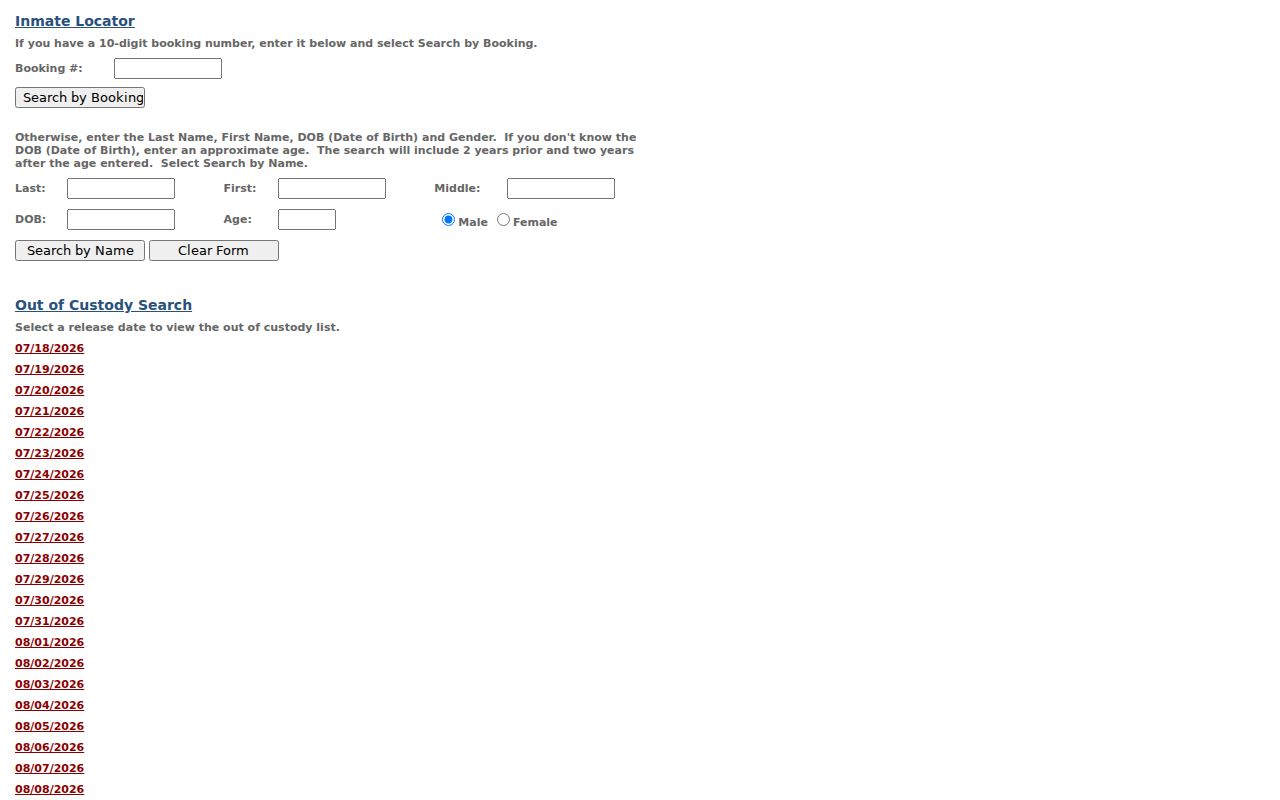
The county lookup is a status lead. Keep it separate from any resident, owner, or historical household conclusion, because custody data shifts and omits as cases move.
Twentynine Palms Cemetery Record Clues
The official Twentynine Palms Public Cemetery District search helps when a name trail ends with a death. It also helps with a memorial or military connection. Fields cover first, last, born, died, interred, cemetery, section, block, lot, and veteran status. Results may carry the full name and a variant, plus placement. They may also carry birth, death, and interment dates, rank, branch, war service, space type, and memorial detail.
Those details can connect a deceased person to base publications, oral histories, or an obituary. They do not establish a last residence. Match a cemetery result against a newspaper date or middle-name variant. A deed, probate record, or family source works too, before it enters a Twentynine Palms residents directory timeline. The official cemetery interment search displays the fields that make this careful match possible.
Note: Cemetery placement can corroborate a dated name trail, but it does not establish where a person last lived.
Twentynine Palms Business License Trails
A business filing helps separate one name from another. Still, an entity address is an address of record, not proof anyone lives there. The California bizfile search handles names and file numbers. Advanced controls cover contains, keywords, starts-with, entity type, status, and filing date ranges. A result lists the entity number, formation date, status, jurisdiction, street and mailing address, agent, Statement of Information due date, and filed officers or managers. Open the dated filing PDF before trusting any address or role.
The California Department of Consumer Affairs license search returns board, license type and number, name, public address, issue date, expiration, status, and discipline history. Some boards run separate systems. San Bernardino County FBN statements and the city business-license route add local Twentynine Palms context. Together these records tie a business or license to a person. They fix that tie at a point in time. They do not prove beneficial ownership or a home address. The California bizfile search and DCA license search display these distinct fields side by side.
Pick the right Board or Bureau before searching professional records. Then date every address or status in the Twentynine Palms residents directory note to the filing that reported it.
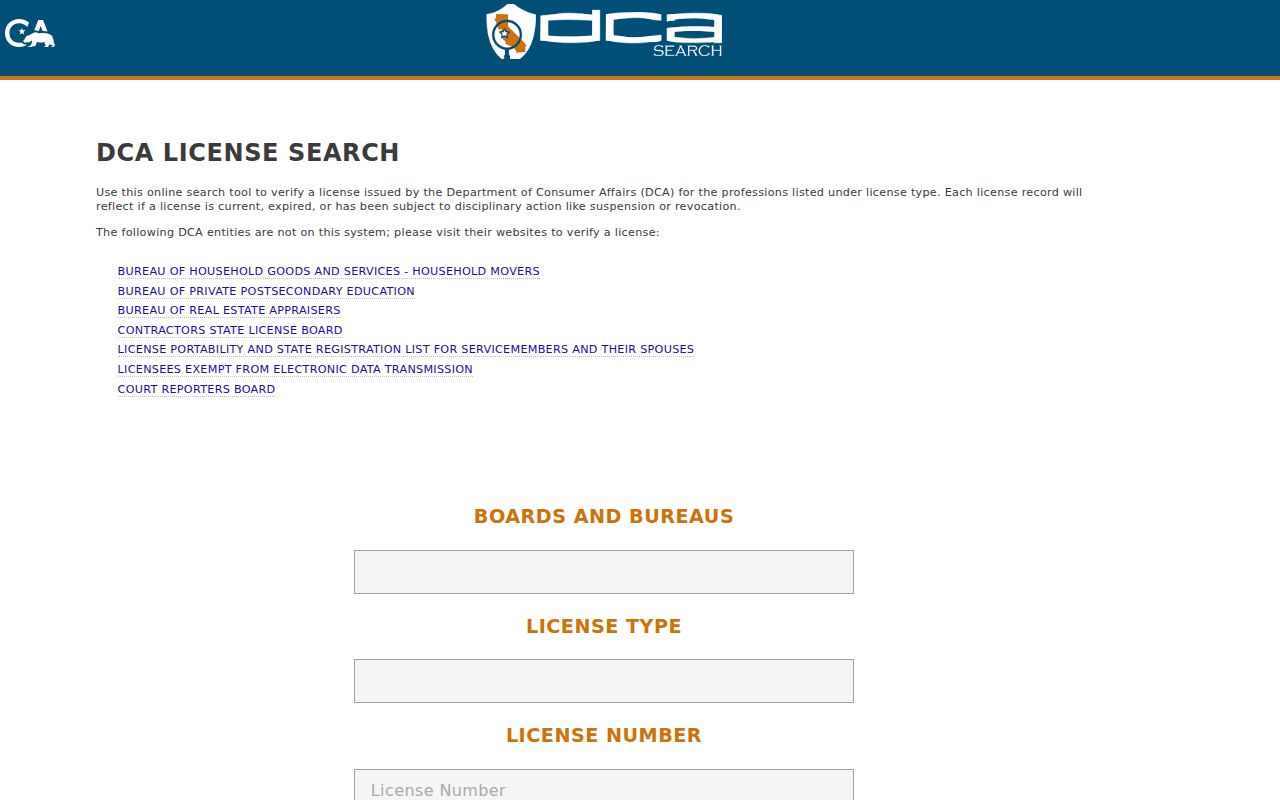
A public license address may be a practice, mailing, or official business address. Record that precise description whenever a resident lookup in Twentynine Palms cites it.
Twentynine Palms Records Requests
Not every record lives online. When something you want is missing from the web, ask for an existing document. Ask instead of a new resident list. The Twentynine Palms public-record route works best when you name a specific series, the office that holds it, a subject, and a bounded date range. City departments that field these requests include the clerk, planning, building and safety, code enforcement, and finance or business licensing. CitizenServe serves as the city's posted channel for permits and licenses. Its module fields and coverage dates, though, are something to confirm with staff before relying on them.
County material goes through the ARC public-records request procedure. The California Public Records Act, Government Code Division 10, sections 7920.000 through 7931.000, generally gives the custodian ten days to decide. The decision is whether records will be disclosed. Unusual circumstances can add a written fourteen-day extension. Treat that window as a determination deadline, not a guarantee that copies arrive within ten days.
A strong request names the record, any parcel or case identifier, the subject, the custodian, and bounded dates. Ask for segregable public portions. Expect protected details to come back redacted. For older material, the county Archives page remains the fallback. It covers lot books, probate files, Great Registers, and similar county holdings. The building is described as closed, so contact staff before making the trip.
Lawful personal use. Public records support family history, civic review, property curiosity, and record correction. Do not use a Twentynine Palms residents directory result to stalk, harass, threaten, or harm anyone.